
Types of Data
This article gives you a brief overview of the data categories that you can find in the navigation panel of MDM Web App.
Master data
Master data is the consolidated, trusted view of the data managed in MDM. Master records are also referred to as 'golden' records.
You create master data in one of two ways:
-
Consolidated records are created through the consolidation process, where instance records from one or more source systems are cleansed, matched, and, if required by the use case, merged into a master record.
-
Authored records are created directly in the master layer to add data that is not available in any connected source system.
The master data view contains records that have been mastered by MDM. In MDM Web App, you can view, edit, and otherwise manage these records.
Mastered entities fall into two groups:
-
Key domain entities, such as customer or party. Records that represent the same real-world entity are matched across source systems and merged into one master record.
-
Related entities, such as addresses, contacts, or M:N relationships. These records are deduplicated within the context of their parent record rather than matched across sources. The resulting records are sometimes called silver records.
Mixed style refers to the combination of consolidated and authored records as it applies centralized, coexistence, and consolidation styles, where master data exists both in the MDM hub (R/W) and source systems (R/W). For more information, see Mixed Style in MDM.
Instance data
Instance records are all records loaded into MDM from source systems, across all entities in the data model: for example, customers, addresses, contacts, and M:N relationship records. Each source record corresponds to exactly one instance record.
Instance records can be further processed, that is, cleansed, matched, and mastered. They can also be loaded without mastering and provided to consuming systems as they are, for example, contextual data loaded alongside the mastered entities.
The term instance data is used in two ways:
-
In the broader sense, instance data is the whole instance layer in MDM. Each instance record holds the source data together with its cleansed form and its matching and aggregation information.
-
In the narrower sense, instance data is the source data as loaded into MDM, that is, the source layer only.
The number of instance records is the same in both cases. The additional layers add information to each record but do not add records, and deduplication or matching does not reduce the count. For more information about the instance and master layers, see MDM Model.
To find out more about splitting and merging instance records from master records, see Merging and Splitting Records, section Split and merge instance records.
Reference data
Reference data is a subset of master data. Within MDM Web App, reference data limits the set of allowed values for attributes.
Datasets
Datasets are two or more tables joined into a single view with user-picked attributes, letting data stewards search for and view data in a flexible way. Datasets are configured by the project developer and cannot be changed in MDM Web App.
Each dataset has a representative entity assigned to it, which determines which record opens when you click an entry in the dataset listing. For example, if a dataset consists of columns from three tables: Party, Address, and Contact, and the project developer has assigned Party as the "core" entity, then a record from the Party entity opens.
You can verify whether datasets are configured by looking for Datasets in the left navigation panel.
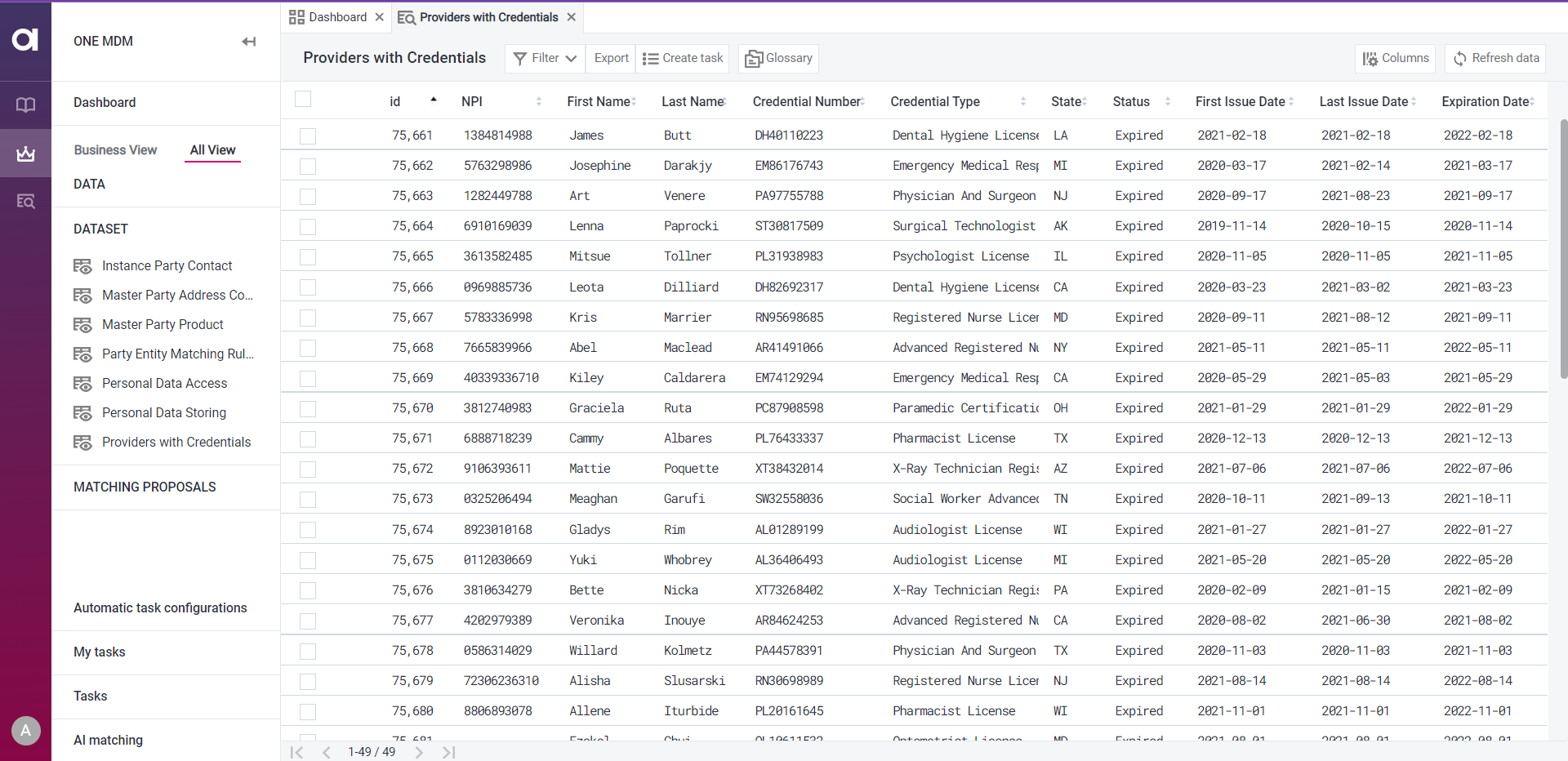
Matching proposals
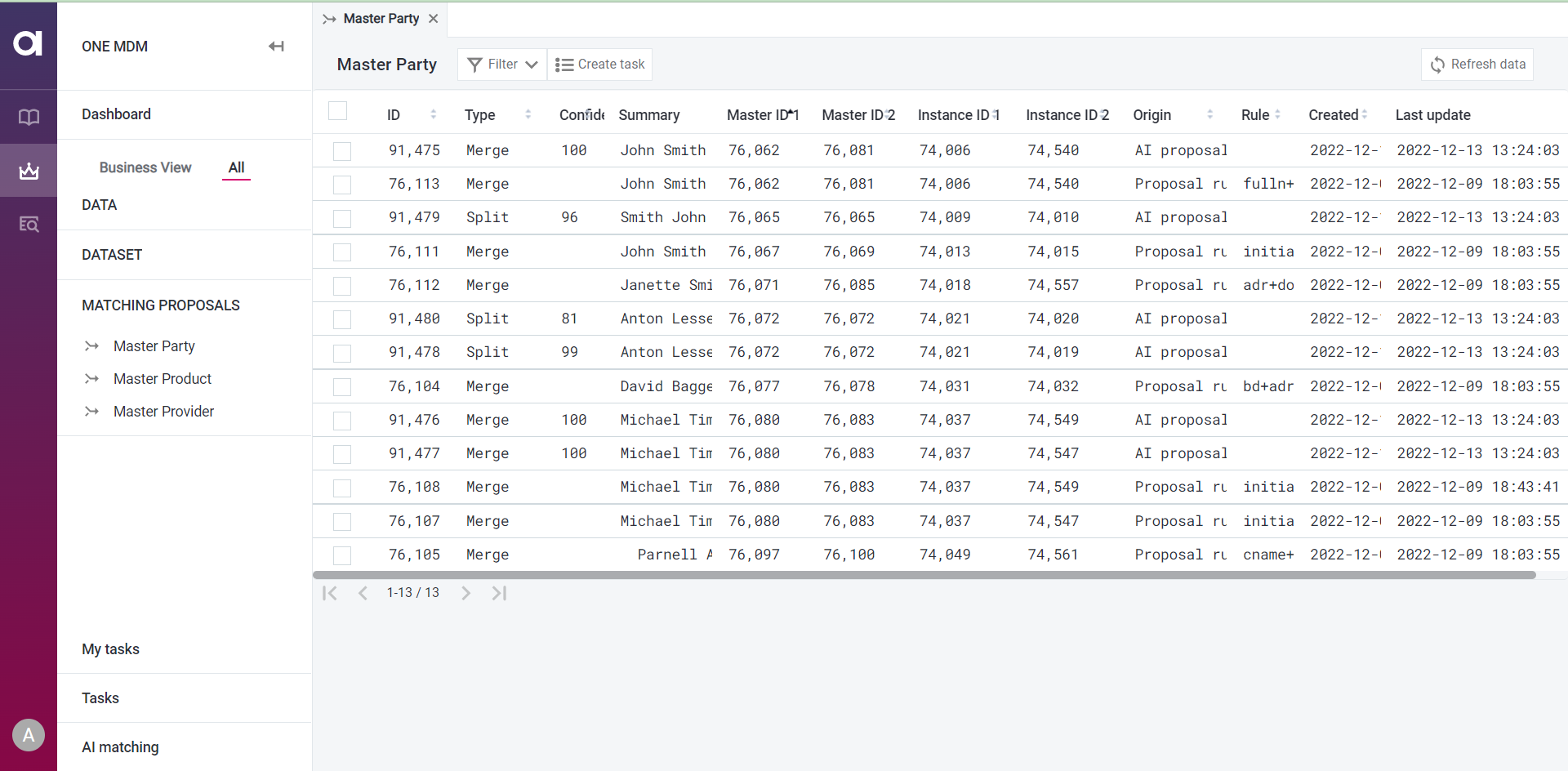
Matching proposals are suggestions for merging data that is generated in MDM Matching step and by AI Matching service that require manual resolution. They allow to effectively detect data that should be merged but was not merged automatically.
Matching proposals from both sources can be accessed from Matching proposals listing. You can resolve them yourself or create a task for other team members.
Was this page useful?